

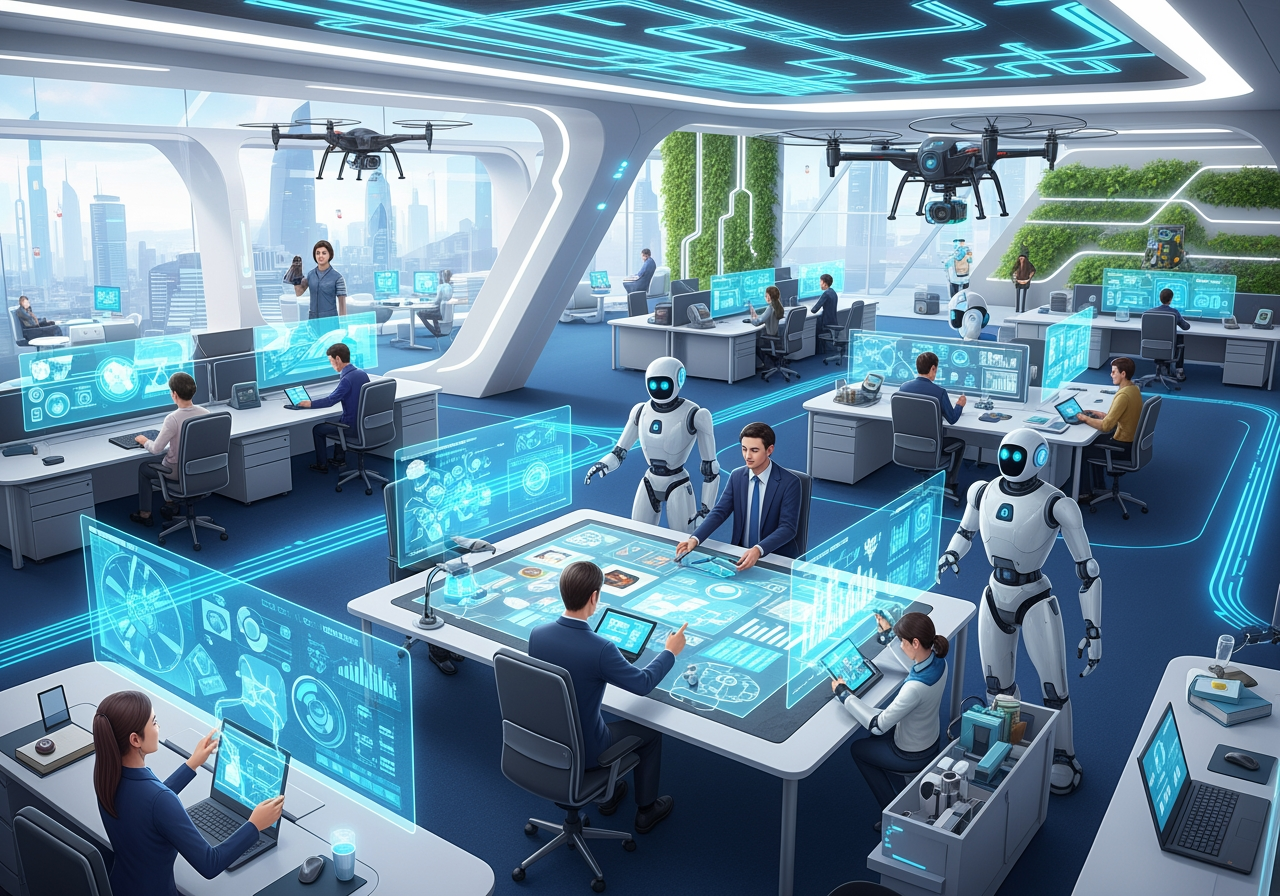
Generative Artificial Intelligence (GenAI) has transcended experimental stages to revolutionize content creation across various domains. As this technology continues to evolve, the future trends of Generative AI promise to bring about profound changes in how we work, learn, and innovate.
In the upcoming years, we can expect the following trends to shape the landscape of Generative AI:
Integration into Daily Workflows:
– GenAI will seamlessly integrate into everyday tools like email, design software, coding environments, and business platforms.
– It will assist in drafting, suggesting, and automating repetitive tasks, allowing humans to focus on higher-level tasks.
Multimodal Capabilities:
– Future GenAI systems will be able to understand and generate text, images, audio, video, and code simultaneously.
– For instance, a single prompt could generate a complete marketing campaign with visuals, scripts, and copy, streamlining creative workflows.
Personalisation at Scale:
– GenAI will enable deep personalization across industries, such as personalized education content, customized healthcare guidance, and tailored marketing strategies.
– By adapting to individual preferences and learning styles, GenAI will enhance the effectiveness of interactions.
GenAI in Software Development:
– The adoption of GenAI in software development will lead to AI-assisted coding, automatic documentation generation, code optimization, and the rise of low-code platforms.
– Developers will transition from writing every line of code to overseeing AI-generated outputs, improving efficiency and productivity.
Emphasis on Responsible and Regulated AI:
– With increasing power, GenAI will be subject to enhanced regulation focusing on transparency, bias reduction, data privacy, and clear labeling of AI-generated content.
– Responsible GenAI practices will be crucial for building trust and ensuring ethical use of AI technologies.
GenAI in Education:
– GenAI will revolutionize education through personalized tutoring, adaptive learning paths, instant feedback, and creative learning materials.
– Teachers will leverage GenAI as a support tool to enhance the learning experience while maintaining human guidance.
Industry-Specific Models:
– Future GenAI will feature domain-specific models tailored for industries like healthcare, finance, legal services, and manufacturing.
– These specialized models will offer higher accuracy, compliance, and relevance compared to generic AI solutions.
Creative Collaboration Between Humans and AI:
– GenAI will serve as a creative collaborator for artists, writers, designers, and musicians, enabling them to explore ideas, experiment with styles, and overcome creative blocks.
– Human creativity will remain central, with AI expanding possibilities rather than replacing human expression.
Knowledge Work Transformation:
– GenAI will automate research, summarisation, and analysis tasks, allowing professionals to focus on critical thinking, interpretation, and strategic planning.
– Professionals will view GenAI as a productivity multiplier rather than a tool for job replacement.
Democratisation of Creation:
– GenAI will democratise creation by lowering barriers for individuals with minimal technical skills to create content, build applications, launch businesses, and learn complex subjects.
– This democratisation could unlock innovation on a massive scale, fostering creativity and entrepreneurship.
In conclusion, the future of generative AI is characterised by collaboration, responsibility, and creativity. By working in harmony with GenAI, individuals can harness its potential to accelerate innovation, learning, and problem-solving. Embracing GenAI today will empower individuals to shape a digitally advanced world tomorrow, where human ingenuity and AI capabilities coexist harmoniously.