

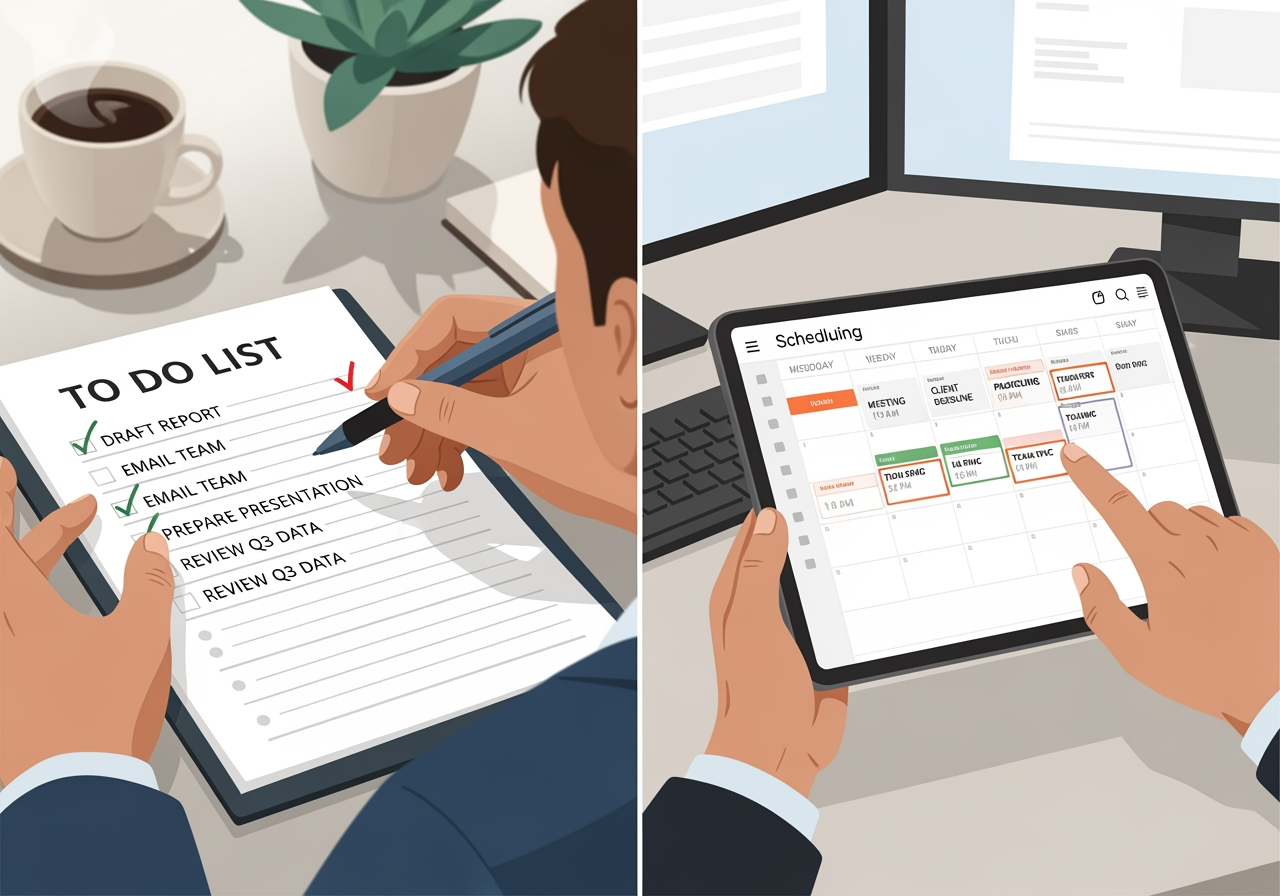
Productivity is a common goal for individuals across various fields, including students, professionals, and entrepreneurs. To achieve this goal, many rely on two primary tools for organizing work: to-do lists and schedules. While these tools may appear similar, they serve distinct purposes that can significantly enhance efficiency and concentration.
A to-do list is a straightforward compilation of tasks that need completion. It does not specify when these tasks should be undertaken, only that they must be done. The advantages of to-do lists include their simplicity in creation and maintenance, flexibility to rearrange or skip tasks, motivation from checking off completed items, and the ability to capture all tasks without concern for timing. However, they can become overwhelming if too lengthy, lack guidance on task timing, and may lead to procrastination on challenging tasks.
In contrast, a schedule assigns tasks to specific time slots or blocks throughout the day, offering a more structured approach than a to-do list. Schedules often include start and end times for each activity, aiding in time management, reducing multitasking and distractions, providing predictability in task execution, and facilitating accountability in measuring progress against deadlines. Nevertheless, schedules are less flexible, can feel restrictive for creative work, and may induce stress if over-scheduled.
To-do lists are ideal for short-term or simple tasks, brainstorming, prioritizing urgent tasks, and managing personal errands or small work items. On the other hand, schedules are best suited for tasks with strict deadlines, deep work or study sessions, managing multiple responsibilities across time blocks, and coordinating with teams or external commitments.
A hybrid system that combines both to-do lists and schedules is often the most effective approach to maximizing productivity. This involves starting with a comprehensive to-do list, prioritizing tasks based on urgency, importance, and priority level, allocating time blocks in a schedule for high-priority tasks, and utilizing the to-do list for flexibility in handling smaller or low-priority tasks.
Additional tips to enhance productivity include setting realistic goals, time-blocking for deep work, daily review and adjustment of tasks, using digital tools like Todoist, Notion, Google Calendar, and Trello, and breaking tasks into smaller steps for easier scheduling and completion.
In conclusion, neither a to-do list nor a schedule is inherently superior; the choice depends on individual tasks, deadlines, and work preferences. Beginners may begin with a to-do list and transition to scheduling important tasks, while experienced professionals often integrate both methods for optimal productivity. By recognizing the strengths and limitations of each approach, individuals can design a personalized system that boosts productivity, minimizes stress, and ensures the completion of essential tasks without feeling overwhelmed.